First you're another Sloe-eyed vamp.
Then someone's mother, then you're camp.
Then you career from career to career.
I'm almost through my memoirs.
And I'm here.
Now that we've solved the riddle, it's time to reacquaint ourselves with the layout of Stuff & Nonsense VII: Mother Goose Suite, which was planned in 2024. The piece will be scored in 6 movements, written in the key of G major for "goose." I normally quote the themes of each set in the postludes of songs 4 and 7. In this case, each of the Stuff & Nonsense themes from songs 1-6 will be paired with a nursery rhyme.
Mother Goose Suite
Here We Go Round the Mulberry Bush
From Through the Looking-Glass and What Alice Found There, Chapter 4.
Alice and the Tweedles were recalled to have sung it.
This one will be used in each of the 6 movements.
Here we go round the mulberry bush,
The mulberry bush, the mulberry bush,
Here we go round the mulberry bush,
All on a frosty morning.
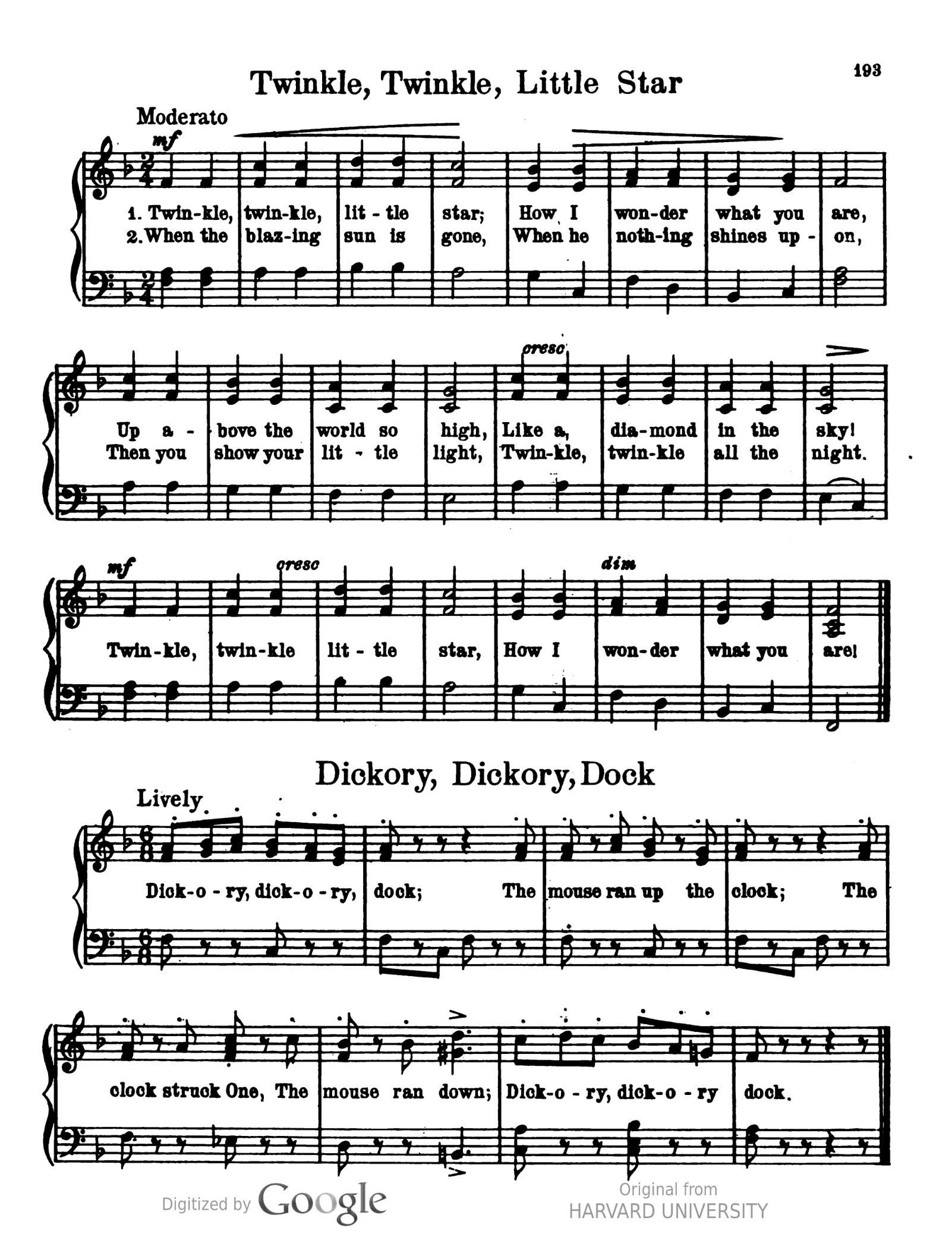
VII.1 Twinkle, Twinkle
From Alice's Adventures in Wonderland, Chapter 7, sung by The Hatter.
The Dormouse interrupts and sings the last 4 twinkles.
Quotes S&N I. The Mouse's Tale, sung by The Mouse.
Twinkle, twinkle, little bat!
How I wonder what you’re at!
Up above the world you fly
Like a tea-tray in the sky.
Twinkle, twinkle—
Twinkle, twinkle, twinkle, twinkle—
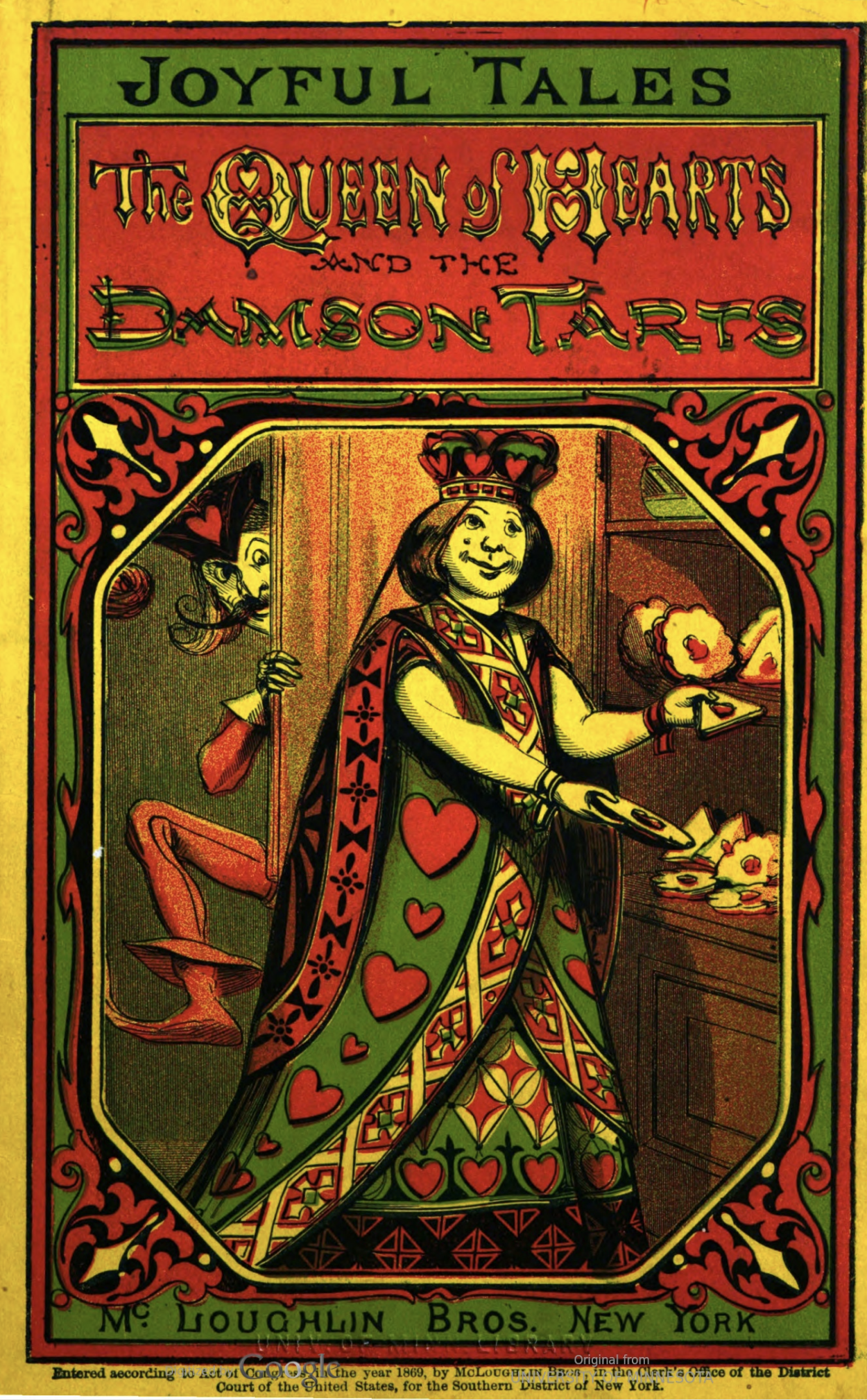
VII.2 The Queen of Hearts
From Alice's Adventures in Wonderland, Chapter 12, sung by The White Rabbit.
Quotes S&N IV. The White Rabbit's Evidence, also sung by The White Rabbit.
The Queen of Hearts, she made some tarts,
All on a summer day:
The Knave of Hearts, he stole those tarts,
And took them quite away!
VII.3 Tweedeldum and Tweedeldee
From Through the Looking-Glass and What Alice Found There, Chapter 4, sung by Alice.
Quotes S&N VI. The White Queen's Riddle, sung by The White Queen & The Red Queen.
Tweedledum and Tweedledee
Agreed to have a battle;
For Tweedledum said Tweedledee
Had spoiled his nice new rattle.
Just then flew down a monstrous crow,
As black as a tar-barrel;
Which frightened both the heroes so,
They quite forgot their quarrel.
VII.4 Humpty Dumpty
From Through the Looking-Glass and What Alice Found There, Chapter 6, sung by Alice.
Quotes S&N V. Humpty Dumpty's Poem, sung by Humpty Dumpty.
Humpty Dumpty sat on a wall:
Humpty Dumpty had a great fall.
All the King’s horses and all the King’s men
Couldn’t put Humpty Dumpty in his place again.
VII.5 The Lion and The Unicorn
From Through the Looking-Glass and What Alice Found There, Chapter 7, sung by Alice.
Quotes S&N III. The Lobster Quadrille, sung by The Mock Turtle.
The Lion and the Unicorn were fighting for the crown:
The Lion beat the Unicorn all round the town.
Some gave them white bread, some gave them brown:
Some gave them plum-cake and drummed them out of town.
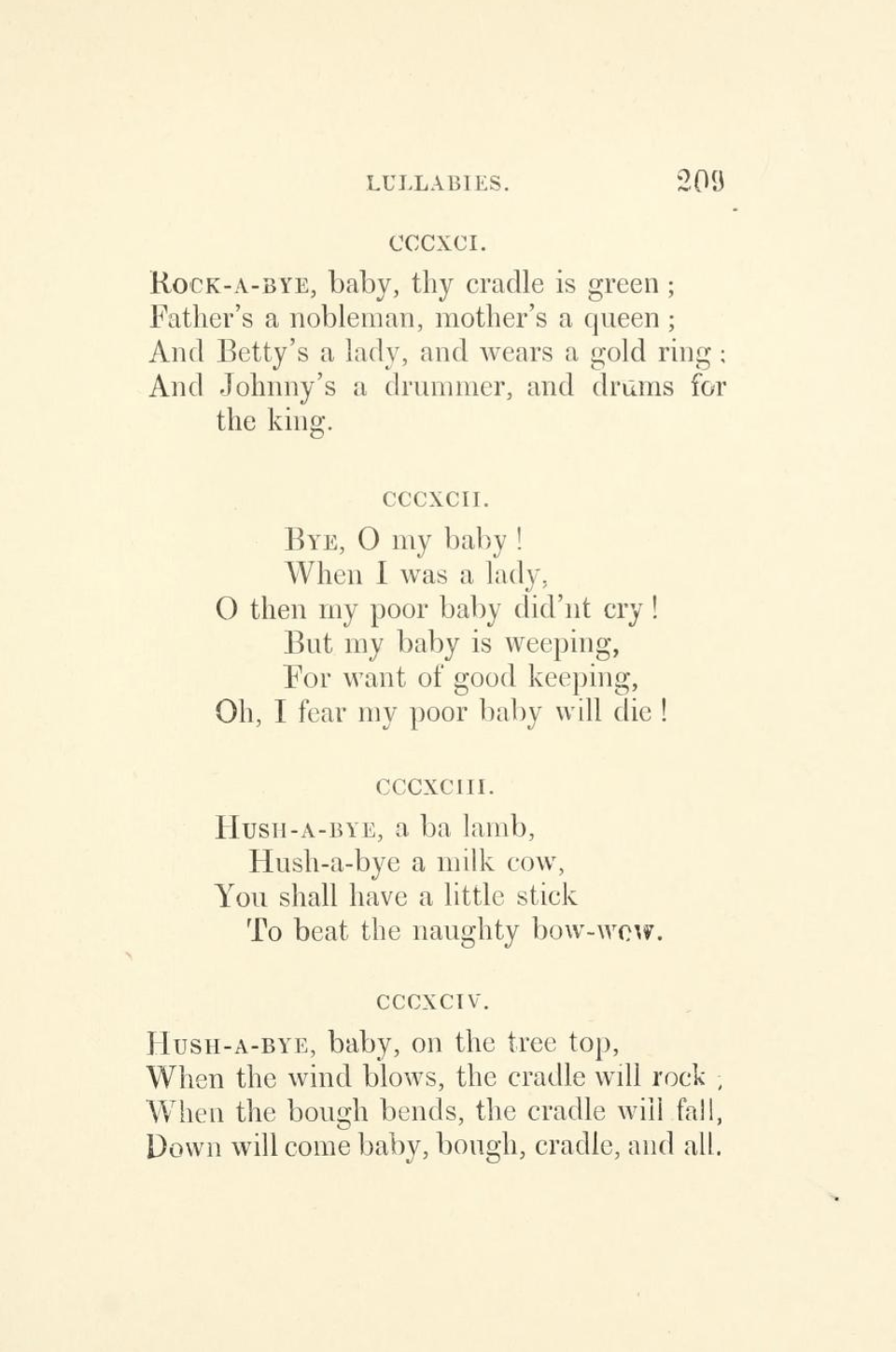
VII.6 Hush-a-by Lady
From Through the Looking-Glass and What Alice Found There, Chapter 9.
Sung by The Red Queen, who then requested that Alice sing it as well.
Quotes S&N II. The Duchess' Lullaby, sung by The Duchess & The Cook.
I'm aware that I finished the last post less than a minute ago.
However, the first post was all about cold, hard facts, and this one will contain some initial ideas and reference material; where the previous post set up the boundaries of my playground, this one will unleash the monsters we'll be playing with.
One idea I had had previously was to build each movement in such a way that it quoted its predecessors, similar to the way many children's stories and songs are structured. Like "There's a Hole in the Bottom of the Sea."
An example of such a structure might be:
1. Mulberry
Twinkle
Mulberry
Twinkle & Mouse's Tale
2. Mulberry
Queen of Hearts
Twinkle & Mouse's Tale
Mulberry
Queen of Hearts & White Rabbit's Evidence
3. Mulberry
Tweedles
Queen of Hearts & White Rabbit's Evidence
Twinkle & Mouse's Tale
Mulberry
Tweedles & The White Queen's Riddle
4. Mulberry
Humpty
Tweedles & The White Queen's Riddle
Queen of Hearts & White Rabbit's Evidence
Twinkle & Mouse's Tale
Mulberry
Humpty & Humpty
5. Mulberry
Lion Unicorn
Humpty & Humpty
Tweedles & The White Queen's Riddle
Queen of Hearts & White Rabbit's Evidence
Twinkle & Mouse's Tale
Mulberry
Lion Unicorn & Lobster Quadrille
6. Mulberry
Hush-a-by Lady
Lion Unicorn & Lobster Quadrille
Humpty & Humpty
Tweedles & The White Queen's Riddle
Queen of Hearts & White Rabbit's Evidence
Twinkle & Mouse's Tale
Mulberry
Hush-a-by Lady & Duchess' Lullaby
Another idea I had was to make sure to quote Twinkle in minor, because it appears that way in the ending fugal section of Father William. How fortunate that this passage was originally scored in G minor, while this suite happens to be in G as well. I'm never reaching for the stars, and yet I'm constantly being inundated with stardust. Somebody or something must love me tremendously, and to quote Twinkle in major would not only be a clumsy misstep, but a rude rejection of such a beautiful gift. We must mind our manners.
In 2024, I had decided that Mulberry Bush, Twinkle, and Hush-a-by (as sung to Purcell's Lillibullero) were worthy melodic quotes, meaning that their scores had been published before 1871 (Through the Looking-Glass and What Alice Found There), and they appear to have been popular enough that Alice readers would have brought them to mind.
My initial conclusions were that the Queen of Hearts "did not pass the test of time," and the Tweedles "didn't lend themselves well to singing." Humpty only passed the margin by 1 year, and there's no indication that either Humpty or The Lion and The Unicorn ever made it big. Though these four contenders aren't as strong as the first three, it's likely I'll use them.
Library of Potential Nursery Rhymes
Sheet Music, 1879
The Singing Master, 1840
Nursery Rhymes with Old Tunes, 1846
British Library Music Collections English Songs Vol. 7, 1775
I'm aware, again, that I finished the last post less than a minute ago. Sometimes it takes three posts before we're organized and ready for hibernation.
I have scores for every nursery rhyme except the Tweedles. But would you know it? Fortune favors the hatters. English poet John Byrom (1692-1763) is credited with the epigram that named the Tweedles in the first place, and those two just so happen to be composers. From 1725:
Some say, compar'd to Bononcini
That Mynheer Handel's but a Ninny
Others aver, that he to Handel
Is scarcely fit to hold a Candle.
Strange all this Difference should be
'Twixt Tweedle-dum and Tweedle-dee!
The nursery rhyme would be printed 80 years later, in Original Ditties for the Nursery. Further investigation into Giovanni Bononcini (1670-1747) reveals that he lived in London from 1720 to 1732, and for that time, he was basically in a popularity contest with Handel. In fact, there was a political divide; the Tories favored Handel while the Whig party favored Bononcini. One of Bononcini's most famous works was his opera Xerse, written in 1694.
Originally, the opera Xersewas composed by Francesco Cavalli (1602-1676) in 1655. The libretto, written by Nicolò Minato, was loosely based on Book 7 of The Histories by Herodotus (484-425 BCE). Nearly 40 years after Cavalli's opera, Bononcini wrote a new opera by the same name, and Minato's libretto was adapted by Silvio Stampiglia. But then in 1738, after another 40 years, Handel (1685-1759) wrote Serse, with Stampiglia's work adapted by an unknown librettist. All three of these operas begin with the aria, "Ombra Mai Fù," in which Xerxes I, the King of Persia, sings tenderly to a tree for providing him shade.
To recap, the original Tweedles were none other than Bononcini and Handel, and both of them are remembered today in part for their renditions of an opera about Xerxes (518-465 BCE), the King of Persia. Coincidentally, the most famous aria in those operas happens to be a song about a tree.
Chapter 4 of Through the Looking-Glass, begins, "They [the Tweedles] were standing under a tree, each with an arm around the other's neck..." Alice then recalls that she and the Tweedles had been singing Here We Go Round the Mulberry Bush, as the music "seemed to come from the tree under which they were dancing..." The white rattle that begins the battle is spotted under a tree. And when the brothers battle, they hit trees. As the monstrous crow enters the scene, Alice hides among the trees. I do believe we have run into some scores for the Tweedles, and composed by the original Tweedles, no less.
Today I've been falling ever more in love with Bononcini, but I don't know why I bother, for I don't intend to keep a shred of the beauty (or even the dignity) woven so carefully into these masterful scores.
Meanwhile, I've started thinking about what kinds of mulberries we'll be bringing to this party.
VII.1 - Mode
Twinkle shall make an appearance in G minor, so we'll probably be needing minor mulberries.
Not to be forgotten is Byrd's glorious Picardy third.
VII.2 - Inversion
The White Rabbits' Evidence is all about the horizontal symmetry of the Dorian mode.
I therefore inverted the Mulberry intervals, which resulted in C minor.
Another way to think of this is reflecting the Mulberries over the horizontal G axis.
VII.3 - Retrograde
We are in the presence of the great The White Queen!
I therefore ordered our Mulberries in retrograde.
Another way to think of this is reflecting the Mulberries over the vertical double barline.
VII.4 - Scale
For Humpty Dumpty, I altered the scale to G whole tone.
The harmonies have morphed into augmented triads.
VII.5 - Meter
"Les Lignets" or "Les Lanciers" from The Lobster Quadrille plans to pay a visit.
Meanwhile, our nursery rhyme here isThe Lion and the Unicorn.
They're both in duple time!
VII.6 - Tempo
This one is a lullaby, with the gentle lilt of Purcell's dotted rhythm.
On Wednesday, my friend Phara asked me if I would consider notating one of her future compositions. I told her that I should probably be outgrabing if I'm going to be notating anything at all, and on Saturday afternoon, I finally opened MuseScore.
The same day, I sent Rebecca an email telling her all sorts of things about the new set. She wrote back yesterday, very politely asking me what the hell I was blabbering on about, so then I started writing this post. You see, before I could open MuseScore, much like the gentle reader sifting through the opening pages of the Through the Looking-Glass, and What Alice Found There, I had to work out a thing or two. For any poem from Stuff & Nonsense, I needed to know its key signature and possible melodic motive, and that meant I needed to solve exactly two puzzles.
Before I get into that, a word on the title "Stuff & Nonsense." The phrase is simply inspired by the poetry of the set; if you sit down and read it all at once, "Stuff and nonsense" would be your most natural and immediate reaction. It also happens to show up towards the end of The Nursery Alice in Chapter XIV:
The way the trial ended was this. The King wanted the Jury to settle whether the Knave of Hearts was guilty or not guilty-that means that they were to settle whether he had stolen the Tarts, or if somebody else had taken them. But the wicked Queen wanted to have his punishment settled, first of all. That wasn’t at all fair, was it? Because, you know, supposing he never took the Tarts, then of course he oughtn’t to be punished. Would you like to be punished for something you hadn’t done?
So Alice said “Stuff and nonsense!”
So the Queen said “Off with her head!” (Just what she always said, when she was angry.)
So Alice said “Who cares for you? You’re nothing but a pack of cards!”
The facts are these:
Outgrabe is the first group of 7 songs.
Stuff & Nonsense is the second, but the 7th song contains 6 parts.
There are also 3 independent "bookend" poems in the collection.
These, with "The Aged Aged Man" and the previously lost "A Wasp in a Wig," make a set of 24.
There's a chart below, but 7+6+6+3+2 = 24.
And of course they do! And so they must! For not only is this a topsy-turvy well-tempered collection, but also, each of the two Alice books has 12 chapters. Nothing has ever been more obvious than the necessity of 24. To Bach and to Carroll, I salute you both with the fervor and gusto my ancestors likely placed towards gods and countries.
I can hear you asking me about that wasp and that wig already, and I'll make it quick. The first thing to know is that the wig is yellow, the second is that it is made of ringlets, and the third is that the wasp had to shave his head of ringlets in order to wear it. The fourth is that the chapter, "A Wasp in a Wig" containing the poem, "A Wasp in a Wig," was discovered in 1974. We do not know with 100% certainty that the chapter was penned by Carroll, but it probably was. We do have the following letter from Tenniel:
My Dear Dodgson: I think that when the jump occurs in the Railway scene you might very well make Alice lay hold of the Goat’s beard as being the object nearest to her hand – instead of the old lady’s hair. The jerk would naturally throw them together. Don’t think me brutal, but I am bound to say that the ‘wasp’ chapter doesn’t interest me in the least, & that I can’t see my way to a picture. If you want to shorten the book, I can’t help thinking – with all submission – that this is your opportunity. In an agony of haste, Yours sincerely, J. Tenniel 1870
Ouch.
So that's our set of 24.
Each of the Outgrabe songs has a different key signature in numbers of flats.
Each of the Stuff & Nonsense songs has a different key signature in numbers of sharps.
The Stuff & Nonsense poems, in chronological order, are:
1. The Mouse's Tale
Alice's Adventures in Wonderland, Chapter 3
2. The Duchess' Lullaby
Alice's Adventures in Wonderland, Chapter 6
3. The Lobster Quadrille
Alice's Adventures in Wonderland, Chapter 10
4. The White Rabbit's Evidence
Alice's Adventures in Wonderland, Chapter 12
5. Humpty Dumpty's Poem
Through the Looking-Glass, Chapter 6
6. The White Queen's Riddle
Through the Looking-Glass, Chapter 9
7. Mother Goose Suite
I. Twinkle, Twinkle (Alice's Adventures, Chapter 7)
II. The Queen of Hearts (Alice's Adventures, Chapter 12)
III. Tweedledum and Tweedledee (Through the Looking-Glass, Chapter 4)
IV. Humpty Dumpty (Through the Looking-Glass, Chapter 6)
V. The Lion and The Unicorn (Through the Looking-Glass, Chapter 7)
VI. Hush-a-by Lady (Through the Looking-Glass, Chapter 9)
*Referenced Nursery Rhyme (Through the Looking-Glass, Chapter 4)
More thoroughly,
Alice's Adventures in Wonderland
Opening: All in the Golden Afternoon
Bookend I: WTC keys
Chapter II: How Doth the Little Crocodile
OG I: 5♭ / B♭ double harmonic minor
Chapter III: The Mouse’s Tale
SN I: 7♯ / C♯ major
Chapter V: You are Old, Father William
OG II: 3♭ / E♭ major
Chapter VI: The Duchess’ Lullaby
SN II: 5♯ / B major
Chapter VII: Twinkle, Twinkle, Little Bat
SN VII.1: 1♯ / G major
Chapter X: The Lobster Quadrille
SN III: 2♯ / D major
Chapter X: ’Tis the Voice of the Lobster
OG III: 4♭ / F minor
Chapter X: Turtle Soup
OG IV: 6♭ / G♭ Lydian & major
Chapter XI: The Queen of Hearts
SN VII.2: 1♯ / G major
Chapter XII: The White Rabbit’s Evidence
SN IV: 3♯ / B Dorian
Through the Looking-Glass and What Alice Found There
Before I got to that, I faced the sorting of key signatures and melodic motives.
Luckily, neither task was difficult, and they nearly worked themselves out for me.
Puzzle 1: Which S&N song gets which key signature?
Nursery rhymes ought not be written with too many sharps, and the key of G major happens to coincide with the name, "Mother Goose." One sharp, 7th song, done.
While we're playing with letters, Humpty ought to be written in the key of EGG, which is E major, G whole tone, and G major. Four sharps, check.
Next, we'll play with numbers.
The Mouse's Tale gives us 7 points. 7#s.
Original Mouse Tail from Alice's Adventures Underground, 1864
And what about The Queen's Riddle? There are six parts to it. 6#s.
This leaves us with 2#s, 3#s, and 5#s.
The quadrille is a French dance from the 18th century, so D major fits.
Lullabies are pretty, and B major is absolutely lovely.
That leaves the White Rabbit's evidence in B Dorian.
You see, the most musically striking mode from Outgrabe was our Mock Turtle's Lydian, and what's the opposite of Lydian? Mixolydian, of course! Right? I decided not!
Mixolydian is just a major sound with a minor v chord, so the entire personality is wrapped up in a cadence, whereas Lydian encompasses an altered pentascale, so it's a melodic shift. They're not pure opposites. I would argue, in this moment anyway, that Dorian makes a better foe! Lydian is major, Dorian is minor. Lydian has the sharp 4 and Dorian has the flat 7. But wait, there's more! Dorian has that sharp 6, that raising-of-the-brow sharp 6 right under that flat 7. Perhaps not as glistening as a sharp 4, but then again, "The White Rabbit's Evidence" was never meant to be so glisteny. It was never waiting in the hot tureen!
Well, the finale of Stuff & Nonsense will of course mention all previous 6 themes.
Puzzle 2: Which S&N melody goes with which nursery rhyme?
To tackle this one, we need to know the publication dates of the rhymes and tunes.
Alice's Adventures in Wonderland was published in 1865.
Through the Looking-Glass and What Alice Found There was published in 1871.
The rhymes are all obviously published before these dates, and tunes that aren't don't count.
Twinkle, Twinkle
Roud Folk Song Index 7666
Rhyme - Jane Taylor, 1806
Tune - The Singing Master No. 3, The First Class Tune Book, 1840
There are a few to choose from, but the one we know was alive and well back then.
There are also two Hickory Dickories, but one appears to be more prominent.
It's not ours.
The Queen of Hearts*
Roud Folk Song Index 19298
Rhyme - The European Magazine Vol. 1 No. 4, 1782
Tune - N/A
Scroll down to the Score Gallery to see one that didn't pass the test of time.
(Not to be confused with Roud Folk Song Index 3195, which most certainly did.)
Tweedledum & Tweedledee
Roud Folk Song Index 19800
Rhyme - Original Ditties for the Nursery, 1805
Tune - N/A
Some rhymes simply don't lend themselves to singing as well as others.
Ironically, the original names were used to describe composers Handel and Bononcini.
Poet and "significant landownder" John Byrom, 1725:
Some say, compar'd to Bononcini
That Mynheer Handel's but a Ninny
Others aver, that he to Handel
Is scarcely fit to hold a Candle
Strange all this Difference should be
'Twixt Tweedle-dum and Tweedle-dee!
Humpty Dumpty
Roud Folk Song Index 13026
Rhyme - Juvenile Amusements, 1797
Tune - N/A
The National Nursery Rhymes and Nursery Songs printed this score in 1870.
That means it passes by the margin of one year.
But then, another one took over!
This is simply too unstable a history for all the king's horses and all the king's men.
The Lion and The Unicorn
Roud Folk Song Index 20170
Rhyme - William King 1708
Tune - N/A
I found only two scores, and they have absolutely nothing to do with one another.
Hush-a-bye Baby
Roud Folk Index 2768
Rhyme - Mother Goose's Melody, 1765
Tune - a few, but for this, Purcell's Lillibullero, 1686
Lillibullero is not Outgrabe's quote commemorating the baby oysters.
That one, which is more popular today, was written by Ms. Effie Canning in 1886.
Here We Go Round the Mulberry Bush
Roud Folk Song Index 7882
Rhyme - Popular Rhymes and Nursery Tales, 1849
Tune - Hornpipe from John Gay's The Beggar's Opera, 1728
Popularized by dancer Nancy Dawson; there's some reading posted in the Scores Gallery.
At this point, it is likely you are wondering, "But Lan! Where did 'Here We Go Round the Mulb'ry Bush' come from?" Quite right, very sharp of you! You're adorable first for the question and second for the contraction; I'm so glad you asked.
First of all, we need 7 nursery rhymes for the finale, not 6. For one thing, the numbers say so; we are celebrating 7 all the time. Secondly, even though the song will have 6 movements, the piece as a whole needs something new to bind it together and give it its own character, and this is the Mulberry Bush.
And yes, I can buy dried mulberries and bake with them.
The rhyme is referenced but not spelled out in Chapter IV (Tweedles) of Looking-Glass.
Alice did not like shaking hands with either of them [the Tweedles] first, for fear of hurting the other one’s feelings; so, as the best way out of the difficulty, she took hold of both hands at once: the next moment they were dancing round in a ring. This seemed quite natural (she remembered afterwards), and she was not even surprised to hear music playing: it seemed to come from the tree under which they were dancing, and it was done (as well as she could make it out) by the branches rubbing one across the other, like fiddles and fiddle-sticks.
‘But it certainly was funny,’ (Alice said afterwards, when she was telling her sister the history of all this,) ‘to find myself singing “Here we go round the mulberry bush.” I don’t know when I began it, but somehow I felt as if I’d been singing it a long long time!’
The task was to assign each of 6 rhymes to the first 6 pieces, and wouldn't you know it, but this one worked itself out for me as well.
Twinkle is finished by the Dormouse, so it belongs with The Mouse's Tale.
The Queen of Hearts is part of the court scene involving The White Rabbit's Evidence.
The Tweedles' recitation and The White Queen's Riddle are about oysters.
The Lion and the Unicorn are the land creatures to the sea creatures of The Lobster Quadrille.
Hush-a-by and The Duchess' Lullaby are both lullabies.
is The Mouse's Tale. This is in 7/8 time, just like the opening of Outgrabe was in 7/4; I told you 7 was important. But with Crocodile, we had a very predictable underwater waltz, and this is a bit different. (Now I'm distracted by the vision of Rebecca and me performing Crocodile underwater and I am playing the accordion instead of the piano, and it's such a lovely distraction that I don't want it to end. Rebecca, your pink and purple fascinator stays on your head beautifully underwater).
For Mouse, I use the number 7 haphazardly, meaning 6/8 time with mistakes. All of Stuff & Nonsense generally speaking is lighter, shorter, and more playful than Outgrabe, and its opening number shows it.
Aaron Copland wrote a piano piece called "The Cat and the Mouse." It's much more involved than my little nursery rhyme inspired set, but the idea that you can hear the scurrying of cat and mouse paws in minor seconds is a bit of an influence. The mouse telling the tale/tail is terrified of Alice's cat Dinah, after all.
Anyway, the poem is a visual curving of the tail as you have seen with the 7 red dots, and I needed to incorporate that aspect in my music. So Rebecca's melodic outline is based on this (treble clef, 7 sharps).
I really can't tell you any more about it because I haven't written a thing. But now you know the meter, the key, and the fact that it must incorporate Twinkle, Twinkle. And let's be real, Hickory Dickory Dock shall make an appearance.
Meanwhile, I know what you're thinking. Why have I not yet addressed "Three Blind Mice," Roud Folk Song Index 3753, first published in 1609? Is it not about the severed tails of mice?
Well, I’m thinking about it. The original lyrics are:
Three Blinde Mice,
Three Blinde Mice,
Dame Iulian,
Dame Iulian,
the Miller and his merry olde Wife,
shee scrapte her tripe licke thou the knife
Not only does this have nothing to do with mouse tails, but it might even be about Queen Mary I (also known as Bloody Mary) blinding three Protestant bishops, who in real life, were burned at the stake! Oh, what horrors! Luckily, the "modern" lyrics were well in place by Alice's time.
The Nursery Rhymes of England 1886
(the first edition of which was published in 1842)
Deuteromelia 1609
(Following up on the note from Nursery Rhymes of England)
Deuteromelia 1609
Eureka! That's a C clef,, which means this version is similar to what we know today, but in a minor key. Of course I would put it in a♯ minor, the relative key of C♯ major, which would justify what already appears to be a g𝄪. Maybe that symbol was used as a regular sharp in 1609. And how wonderful would the obscure key of a♯ minor be after we already have the Walrus' a♭ minor? It's like a reflection from the other side of the looking-glass. That, my Cheshire, might be enticing enough for me to turn a blind eye to the burning of the Protestants, which very well may be a merry olde Wives' tale anyway.
Upon examining the rhythm of this poem, I realized that the template above has a typo. Can you find it?
Let us both go to
to law: I will prosecute you.
The word "to" is written twice. At first, this sent me into a fury with the idea that the print I had worked with was a fake. However, after doing some digging, I believe it's not a fake, but rather an early version which includes an error. As I plan to use the poem without an error, I now need new notes! Two steps forward, one step back.
Gather 'round, little children; here's the mouse tale of the day:
In 1865, Oxford printed the very first edition of Alice's Adventures in Wonderland. The Mouse's Tale looked like this. It has two "to's" back to back.
Original 1865 Print
The following year, Macmillan printed the book commercially, and their tail looked like this.
The Mouse's Tale 1866
Carroll didn't like the 1866 print, and why would he? What kind of carving-knifed-up tail looks like that? And so he micromanaged the creation of a new printing plate made by the Oxford University Press around 1880:
OUP Printing Plate
Meanwhile, this Macmillan print from 1889 seems to have used that plate!
Macmillan Printing 1898
A Good Match!
Therefore, I finally have the materials for a new blueprint, and here it is.
New Shape, New Notes
While creating a new tail of notes, I removed the option to include naturals so that all pitches are either ♯'s or 𝄪's. Don't worry; the notes and their spellings are still ridiculous due to the fact that b𝄪 and e𝄪 are enharmonically equivalent to c♯ and f♯. Can you imagine the enharmonic nightmare I was starting before, using ♯'s, 𝄪's, and ♮'s?!
The following video takes you through the melodic pitches of the tail, which is divided into four verses by Carroll himself. The melody line is traced twice: the first time follows the pitches as they appear in the score, and the second is rewritten with enharmonic spellings so they're a little easier on the eyes. It's my job as the Hatter to fix what this sounds like, and I'll get to that in the next section. It's not your problem.
For now, it's important that you can hear the shape of the tail, and that was the point! Draw the tail in the air with your finger as you listen to this ugly, ugly set of pitches!
This one turned out a little dark, but that wasn't my fault. Look at what I was working with.
Fury said to a mouse, That he met in the house,
"Let us both go to law: I will prose-cute you. —
Come, I’ll take no de-nial: We must have a trial;
For really this morn-ing I’ve nothing to do."
Said the mouse to the cur, "Such a trial, dear Sir,
With no jury or judge, would be wast-ing our breath."
"I’ll be judge, I’ll be jury," said cun-ning old Fury:
"I’ll try the whole cause, and con- demn you to death."
Basically, somebody or something more or less says, "I'm bored so I'll have you hanged."
We have seven sharps, four verses, a handful of nursery rhymes (especially Twinkle), scurrying mouse paws (minor seconds), 7/8 time, a melody rigorously based on a picture, and death. What could possibly go wrong?
For all the nonsense already built into this song, I wanted to take advantage of the few opportunities provided for me to be predictable. Each of the four verses are set in 5 measures, and surrounding the verses are five interludes, each of which is 7 measures long. I also stuck mostly with triadic harmonies and steered clear of all the cute things like counterpoint and inversion - it was complicated enough justifying that melody. For the most part, the accompaniment is made of major and minor triads with a few diminished and dominant sevenths, not including passing tones and suspensions.
The tempo is "like a jack-in-the-box with a mouse in the gears," and this song is thoroughly broken. We cadence to the wrong keys, add beats at the wrong time, and end in the most thoughtless half cadence you ever did see. From here, I think the simplest way to proceed is for me to actually take you through the song, section by section.
A. Introduction: setting the stage with our Most Important melodic motive, Twinkle Twinkle.
Twinkle is in D major against its C♯ major accompaniment. I don't really know why, other than the fact that I left it up to the mice, and they didn't really care to be in C♯.
B. Tail 1 - up to the first bend
These cadences are a little bit like when you're riding a rollercoaster and you see the tracks laid out straight before you, but you're suddenly jolted in some other direction. I did my best to write harmonies that suggested an idea that our jack-in-the-box was at one time shiny and new, and back then, it must have followed some sense of logic, pattern, or functional harmony.
A word on the notation in m. 12 on "prosecute" - this is nothing more than a double dotted half note (or one measure long) triplet, but Musescore did not like that. So it looks a lot weirder than it needs to.
Ha! You cannot stop the Hatter.
C. Dickery Dickery Dock
I know, it's Hickory Dickory Dock. But it was a lot of things, and dickery dickery was the funniest one to me. Besides, I'm not actually singing it, so it doesn't matter.
There are two famous melodies for this rhyme, and I opted for the one that appeared to be more prevalent. "The clock struck one, the mouse ran down" is where the two versions collide into the same melody, and I became a lot more rhythmically predictable and harmonically functional there. In fact, the harmony is extremely similar to the one published in the score gallery below from "75 British Nursery Rhymes 1904." And the clock really does strike one in my part.
Oh, that reminds me. Starting with this interlude, you're no longer allowed to just sit there and look pretty during my solos. You have to do something, but I don't know what. If you need ideas, I'm not opposed to you taking swigs of tea, walking around the room dancing, flirting with the audience, or making a hand sign presentation for the nursery rhymes. Bonus points if you can get the audience to join you. It's not every day the Cheshire is being accompanied by a jack-in-the-box, so you might as well do something about it when it does happen to happen.
D. Tail 2 - down to the second bend
Listen for the descent of the tail here - it's so obvious, and the intervals are comically awkward. The cadence is homorhythmic, modal, and slightly slower, which foreshadows a nod to religion. After all, if the Fury gets his say, the mouse stands to meet his maker in just two more verses.
E. Twinkle again, for this is our shining star
We start right where we left off, but this time, both of my hands are actually in D. I guess I listened to the mice! Meanwhile, they've scampered up an octave. It ends with "Twinkle, twinkle, twinkle...." because in the Mad Hatter scene, the Dormouse drifts off, continuing to sing extra twinkles in his sleep.
F. Tail 3 - up and over the third bend
You'll notice this is the only verse by the mouse, so it's marked dolce with a bit of pedal. More matter-of-fact than our last verse, we have the predictable rise in melody and cadence using what the jazz pianists call a "tritone substitution." Conveniently for us, that takes us straight into A♯ minor, and we all know what happens in A♯ minor. Don't tell me you already forgot about this:
G. Three Blind Mice
Notice that I fit exactly that much of the score into the 7 measures allotted for my interlude. What a strange place to end. Curiouser and curiouser!
Meanwhile, let's talk about you. You get to whistle - or use some sort of breath-dependent instrument of your choice - and "waste your breath" on a very badly out of tune and yet simultaneously expressive improv. I wrote something very basic for you to play with. It can be different each time we do it! (Also, the chromatic double neighbor that makes up your motive was handed to us by a Crocodile.)
H. Tail 4 - down to the fourth bend, up and over the fifth bend
Welp, the mouse is doomed.
The fifth bend is so weak that I am calling on you to do microtones! But don't worry - it will be much easier than it sounds. I tell you where to start and end, and I give you sort of an idea of where to peak, and the rest is just a little glissando broken up by words. We'll all be quiet and dying at this point, for the tail is very small and thin here as it ends.
I. Dies Irae, Westminster Quarters
As we're headed for death at the end of the tail, we return to religion once more with two plagal cadences and the recitation of "Dies Irae." The ending of the song occurs in a state somewhere between "mindlessly cheerful" and "downright psychotic."
Your part is gleefully presenting an inarticulate, eerie setting of "Dies Irae" in a major key, and I don't care which octave you choose. I notated it in the higher one just because it was easy to read up there. It's kind of scary.
As time is running out for the mouse in the story of The Mouse's Tale, and a mouse has already run up a clock, my part comes in with your triplet rhythms to ring out the Westminster Quarters. Side note: my favorite musical is Sondheim's Sweeney Todd, and Sondheim uses both the Dies Irae and also the Westminster Quarters in there!
And now to address "the most thoughtless half cadence you ever did see" - you could hear the ending of the song as the result of an insensitive machine, chugging away from its gears with not a care in the world about perfect authentic cadences. Or more dismally, jack-in-the-boxes end abruptly with a certain sound, not unlike those of a mouse trap or tiny guillotine. Personally, I'm too kind to put that sound in there.
Notation and enharmonic spellings - I have two copies of the score: one that follows the pitches from the picture, and one that's easier to read. I had to fight myself on that a little, but Schumann wrote a Romance in F♯ that's published with an extra copy in G♭, and The Mouse's Tale is a lot worse than F♯.
This score link will take you to the enharmonic PDF. Let me know if I'm going too easy on you, and I'll get you the original PDF posthaste!
National [English] Nursery Rhymes and Nursery Songs 1872
Mother Goose's Nursery Rhymes 1877
75 British Nursery Rhymes 1904
Hickory Dickory Dock, courtesy of Wiki
So much drama with this one.
According to Ronald Reichertz in his book, "The Making of the Alice Books," the rhyme was set to music by 1785. This particular score was sent upon inquiry to me by Steve Roud of the Roud Index himself. It comes from the British Library Music Collections English Songs Vol. 7 and is dated, "late 18th century." I wrote to the British Library Music to obtain any further information, and they believe the year 1775 is a good estimate. Other scores obtained from the same publisher, W. Bailey, were listed as 1775-1780, and the other songs bound in the same book roughly span the years of 1700-1780. The British Library also confirmed that the score came with no composer listed.
75 British Nursery Rhymes 1904
Queen of Hearts is listed as a jingle with no score in this song book!
The older meaning of the word jingle is a "catchy array of words in prose or verse."
National Nursery Rhymes and Nursery Songs 1872
Mother Goose's Nursery Rhymes 1877
Echoes from the Nursery 1877
75 British Nursery Rhymes 1904
Songs the Whole World Sings 1915
Humpty Dumpty, courtesy of Wiki
Juvenile Minstrelsy 1852
75 British Nursery Rhymes 1904
Purcell's Lillibullero 1688
The Beggar's Opera 1735
Nursery Rhymes with Old Tunes 1846
The Baby's Opera, A book of Rhymes and The Music by the Earliest Masters, 1877
Songs of the Old Homestead 1886
Songs the Whole World Sings 1915
Rock-a-Bye Your Baby With A Dixie Melody 1918
Part Third of the Complete Repository of Original Scots Slow Strathspeys & Dances 1799-1813
Aside from the nursery rhymes we have been exploring, 10 of the remaining 18 Alice poems by Carroll were based on famous poems of his day. I will refer to these as "origin poems."
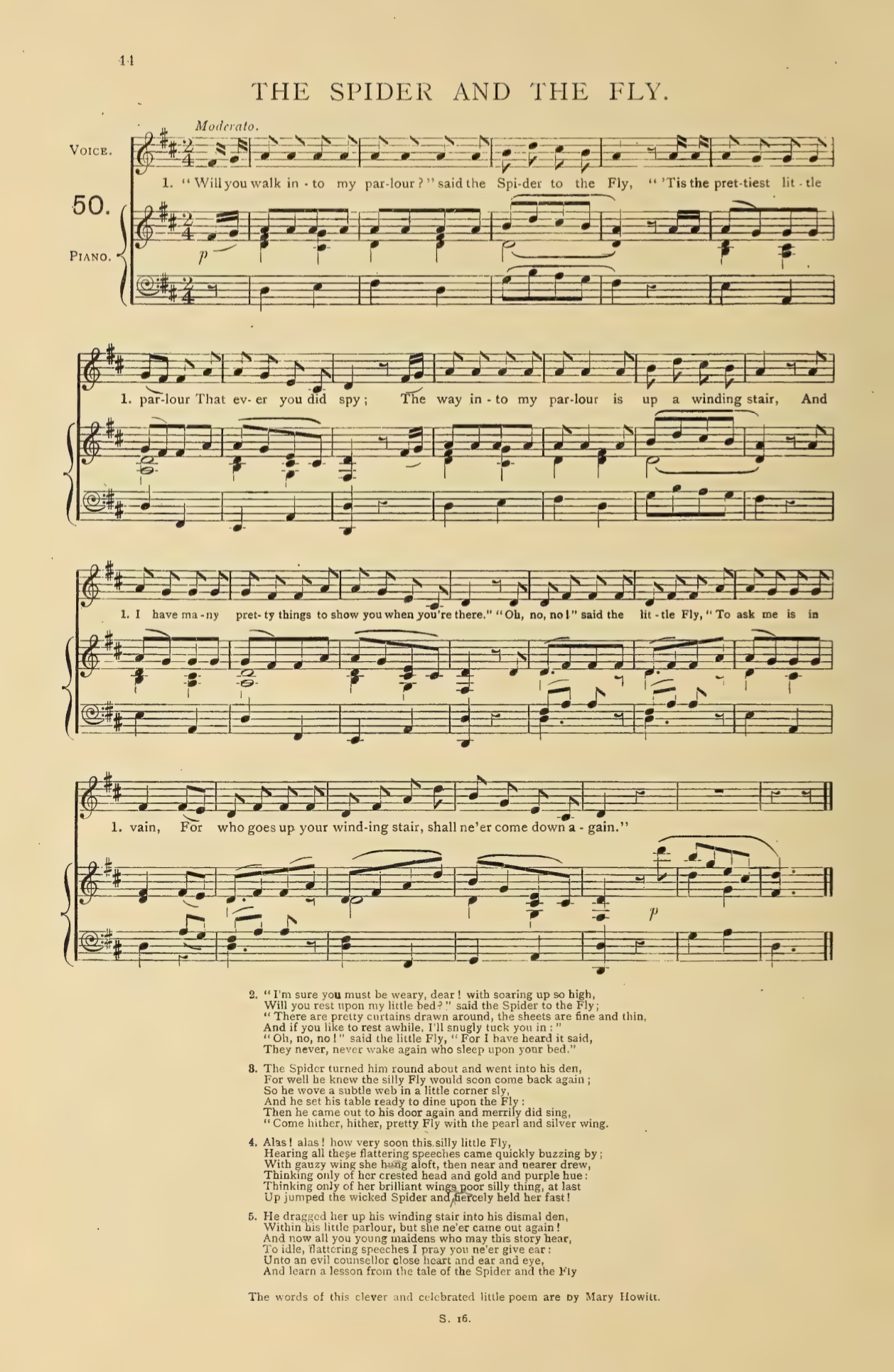
I came across this whilst thumbing through 75 British Nursery Rhymes from 1904.
Well, wouldn't you know it, but "The Spider and The Fly" is the origin poem for "The Lobster Quadrille"!! The score above is a popular tune with arrangements linked below by Russell, Dyer, and Normino. The Mollenhauer setting is part of a different collection of pieces from a comic opera, and the Eastman setting is more of a waltz about the subject matter, and the words have been altered.
Accidentally happening upon "The Spider and The Fly" got me curiouser and curiouser about finding scores to Carroll's other origin poetry. This is what I found.
The left hand column lists Carroll's poetry.
The right hand column begins with the writer of each origin poem.
Underneath the writers are score links listed with the names of their composers.
All in the Golden Afternoon
N/A, Carroll Original
How Doth the Little Crocodile
Against Idleness and Mischief, Watts 1715 No Scores Found
The Mouse’s Tale
N/A, Carroll Original
You are Old, Father William
The Old Man's Comforts, Southey 1799 No Scores Found
The Dream of Eugene Aram, Hood 1831 No Scores Found
Humpty Dumpty's Poem
N/A, Carroll Original
The Aged Aged Man ♬
Resolution and Independence, Wordsworth 1802 No Scores Found The tune Alice recognized, however, is My Heart and Lute, Moore Undated My Heart and Lute, Moore Undated